
Podcast: Play in new window | Download
Welcome back to Monday Matters! Recently, Will attended his nephew’s naval flight school graduation. While at the graduation, an Admiral gave a speech to the graduates that centered around these three main points: Know your mission, be decisive, and invest in your people. This week, Will Parker and Jen Schwanke take some time to reflect on those three points and talk about how they apply to the role of a principal. Listen in to hear the full conversation! Below is an article written by Will to accompany this week’s episode.
Lessons from a Naval Flight School Graduation
William D. Parker
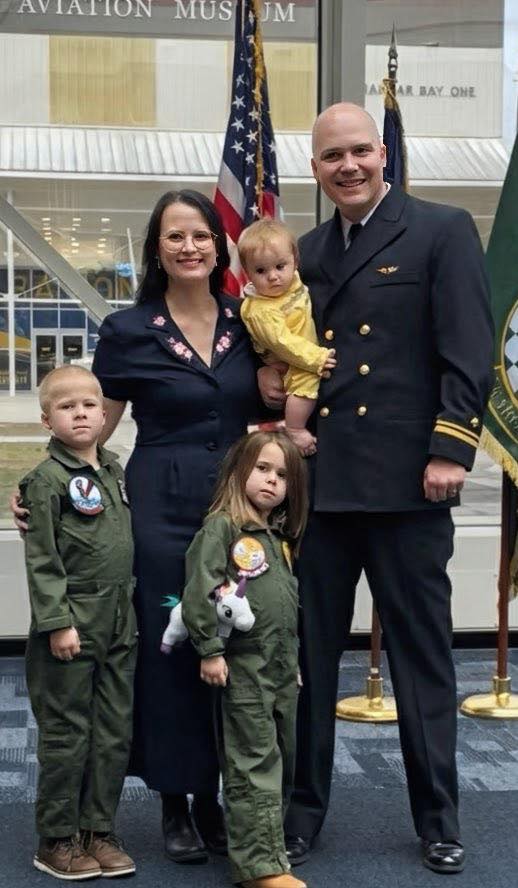
Last week, my wife and I met family members in Pensacola, Florida, to celebrate the graduation of my nephew, Stephen, who received his wings as a flight officer. The ceremony was held at the National Naval Aviation Museum, and officers from several command groups were being honored. Among the hanging planes, flying colors, and many command officers on stage, an Admiral visiting from his post in Washington, D.C., addressed everyone with three reminders for the soon-to-be flight officers to keep in mind:
- Know your mission.
- Be decisive.
- Invest in your people.
Of course, he applied each of these principles to the leadership required for officers in difficult situations that require clarity, firm responses, and a deep understanding of both practice and combat situations.
As I listened, I immediately began thinking about the conversations I have with school leaders. Each day, you have a similar pathway in front of you.
People want to know that what they are doing has a purpose and goal in mind beyond the day-to-day operations of “doing school.” I like to call this the “walk to the front door speech.” Each day, when you arrive at school, you have a question to answer: Why are you here?
You can either tell yourself the story that your purpose is to put out fires, keep school from descending into chaos, or wish everyone would just get along. Or you can remind yourself that ultimately you want to provide solutions to challenges, help resolve conflicts and restore relationships, and build a community where students and teachers can flourish. One of those statements is rooted in mission, while the other is rooted in fear. Choose the mission.
Second, you must be a decisive leader. This does not mean a rash or impulsive leader. Decisiveness means you learn how to analyze the variables in front of you, consider the options available, and then make a choice. Once you make that choice, you move ahead with confidence.
I remember one day when we had an alert of a potential threat on campus. I was with one of our security personnel at the time, but the call was mine to make on next steps. Without going into details that would divulge confidentiality, we decided to watch video surveillance to see if the report was reliable, and when it appeared clear that it was, we took action to secure a location and bring a student in for questioning. When I looked back at the situation later, I realized several steps we could have taken instead of the ones we chose. However, in the moment, our decisiveness isolated the situation and brought it to a quick and safe resolution.
Of course, not every situation requires that kind of safety decision-making. Whatever decision you are making, you will have time to reflect and reevaluate after implementation, but hesitating on action sends signals to others that school is a place of instability instead of stability. You will also never have 100% buy-in from others when you are a decision-maker. The goal is not agreement, however, but action that is based on your policies, practices, experience, and environment. Even though you never make perfect decisions, you do find over time that some decisions become second nature when you are confronting similar ones moving forward.
Finally, I appreciated the reminder that relationships matter. When you are stepping into any kind of environment, people need to know you care about them as much as you care about the outcomes. When we invest in knowing people, spending time with them, learning about their families and their hobbies, and appreciating them as people, they tend to see you not just by your title but also as a person. This works for everyone in your community: bus drivers, office staff, teachers, cafeteria workers, counselors, parents, and students.
I don’t want to create any unrealistic expectations that the goal is for everyone to like you. Instead, the goal should be to earn their respect by how you lead. And we are much more likely to respect someone who is clear and kind. Leaders can be both.
In order for my nephew Stephen to receive his wings, he had to undergo months of training in classrooms and in the air. When I saw him walk across that stage and watched as his wife and three young children surrounded him for a group photo, I was reminded that he was experiencing a milestone. At the same time, he is just beginning a new adventure.
Last week, a young man who is a junior at a nearby university reached out to me by email. He is pursuing a future in education, and he listens to my podcast. I was humbled and encouraged by his curiosity and his desire to learn as much as he can about leadership—even before he finishes his undergraduate degree. His curiosity reminded me that our work never stops, whether we are leading at a school level or supporting those who are. I encouraged him to reach out to other education leaders he admires, and I introduced him to a friend to start his next conversation.
Talking to him reminded me that the principles involved in building and leading schools are not a secret formula. Just as I watched a Navy Admiral pass along lessons to new flight officers, those lessons are transferable from generation to generation.
Know your mission. Be decisive. Invest in others.
These truths may not make the journey easier, but they are certain to lead to better outcomes.