
Podcast: Play in new window | Download
A Quick Note to Listeners:
Before each week’s interview, Will Parker and Jen Schwanke spend some time answering a listener question. This week’s question is:
What advice would a teacher want to give to a new principal?
Listen in to hear their response!
Meet Tyler Watkins:
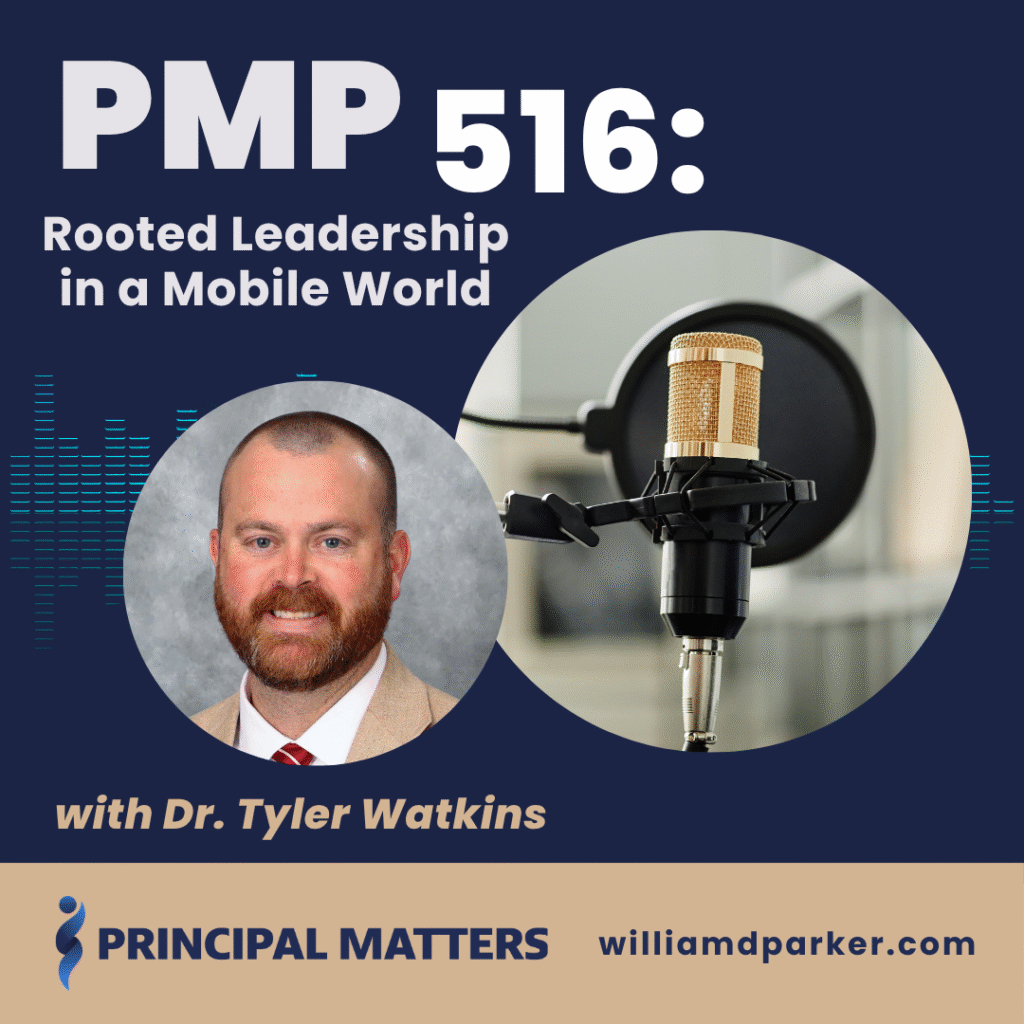
Tyler Watkins, Ed.D., is the principal of Petal High School, one of Mississippi’s top-rated high schools and a 2022 National Blue Ribbon School. He began his career in 2011 as a teacher and baseball coach before moving into school leadership.
His work centers on building belonging, creating predictable systems, and leading through stability. Dr. Watkins earned his doctorate in Educational Leadership from William Carey University, where his research focused on the academic effects of student transiency.
He lives in Petal, Mississippi, with his wife, Katie, and their children, Lowe and Cohen. He is the author of Rooted Leadership in a Mobile World: Belonging, Predictability, and Purpose When Students Come and Go, scheduled for release in Fall 2026.
Why This Work Matters:
Dr. Watkins’ passion for this topic didn’t begin with theory. It began with what he was seeing every day. Students were constantly entering and leaving his school, and even in a high performing system, each new student was starting over. That led him to ask a deeper question, what are we doing to make students feel rooted, even when their lives are not. In today’s landscape of school choice and increased mobility, this isn’t a niche issue. It is everywhere. Whether a school is high performing or struggling, students are navigating transitions, and schools must be ready to respond.
It’s Not Just Academic, It’s Human:
One of the biggest shifts Dr. Watkins describes is recognizing that student mobility is not just an academic issue, it is a human one. New students are not simply catching up on content. They are trying to understand new teachers, new systems, and new social environments, often while carrying emotional weight from their transitions. Too often, schools focus first on academics. But Dr. Watkins emphasizes that stability has to be intentionally designed, not assumed.
Start with the First 10 Days:
At its most practical level, Dr. Watkins encourages leaders to focus on the first 10 days of a student’s experience. Every new student should have a clear plan, not just a schedule. That plan should include intentional check ins, clear expectations, and a structured way to help them navigate the building. Without this, students are often left to figure things out on their own, which increases stress and disconnect.
Every Student Needs an Adult Connection:
Along with a clear plan, every student needs an immediate connection with a trusted adult. At Petal High School, Dr. Watkins and his team assign students to an administrator and counselor by alphabet, and they meet them right away. It is simple, but it matters. Students need to know someone knows their name, where to find them, and how to reach out when they need help. That connection is often the difference between feeling lost and feeling grounded.
Consistency Reduces Stress:
Another key insight Dr. Watkins shares is the importance of consistency across classrooms. It is overwhelming for students, especially new ones, to relearn expectations from class to class. Schools must align expectations so students can focus on learning rather than constantly adjusting to different systems. Clarity and consistency do not just support behavior, they create stability.
Communicate Early with Families:
Dr. Watkins also highlights the power of early communication with families. A simple message home letting a parent know their child had a great day can immediately build trust and connection. These small moments send a clear message, your child matters here, and we are paying attention.
High Expectations with High Support:
A common misconception is that schools must choose between being welcoming and maintaining high expectations. Dr. Watkins challenges that thinking. You do not lower expectations for new students, you increase support. You teach the systems, clarify confusion quickly, and give students the tools they need to succeed. Confusion should not be punished, it should be addressed with clarity.
Leadership Sets the Tone:
This work does not happen by accident. It is a leadership responsibility. Dr. Watkins emphasizes that leaders must design systems that create predictability and ensure consistency across the school. Teacher attitudes toward new students are critical. When staff see new students as opportunities instead of interruptions, it changes everything. Leaders set that tone through clarity, communication, and example.
From Classroom to Campus Leadership:
Reflecting on his own journey, Dr. Watkins describes a shift many leaders experience. As a teacher, the focus is on running a great classroom. As a principal, the focus becomes building a school where every classroom reflects that same level of excellence. For new leaders, he offers practical advice. Set clear expectations, follow through consistently, protect instructional time, and keep systems stable. These foundational practices create the environment where both students and staff can thrive.
Belonging, Predictability, and Purpose:
At the heart of this conversation are three essential elements, belonging, predictability, and purpose. Dr. Watkins emphasizes that students need to feel known. They need systems they can rely on. And they need to understand that what they are doing matters. When those elements are in place, students can succeed, even in the middle of constant change.
What Students Need to Succeed:
Drawing from Ruby Payne’s research on under resourced learners, there are key resources every student needs in order to thrive in school.
- Financial resources
- Emotional stability and self regulation
- Mental and academic skills
- A sense of purpose or direction
- Physical health
- Support systems such as family, friends, and trusted adults
- Motivation, persistence, and grit
- Knowledge of hidden rules, expectations, and social cues within a school
For students who are constantly moving, many of these supports are disrupted. That is why schools must intentionally step in to provide them.
Final Thoughts:
Dr. Watkins leaves us with a reminder that is both simple and powerful. Students do not need perfect schools, they need stable ones. And that is something every leader can influence.
Below are some ways to stay connected to Dr. Watkins:
- Tyler’s new website: https://www.rootedleadership.io
- School website: https://www.petalschools.com/
- Tylers’ email: tyler.watkins@petalschools.com