Podcast: Play in new window | Download
A Quick Note to Listeners:
Before each week’s interview, Will Parker and Jen Schwanke take some time to answer a listener question. This week’s question is:
I’m new to my role as a principal after years as an AP, and I’ve set my calendar for what I believe are the most important priorities. How do I prepare for the unknowns — those responsibilities or expectations I won’t be aware of until they happen for the first time?
Listen in to hear their response!
Meet Kurtis Hewson:
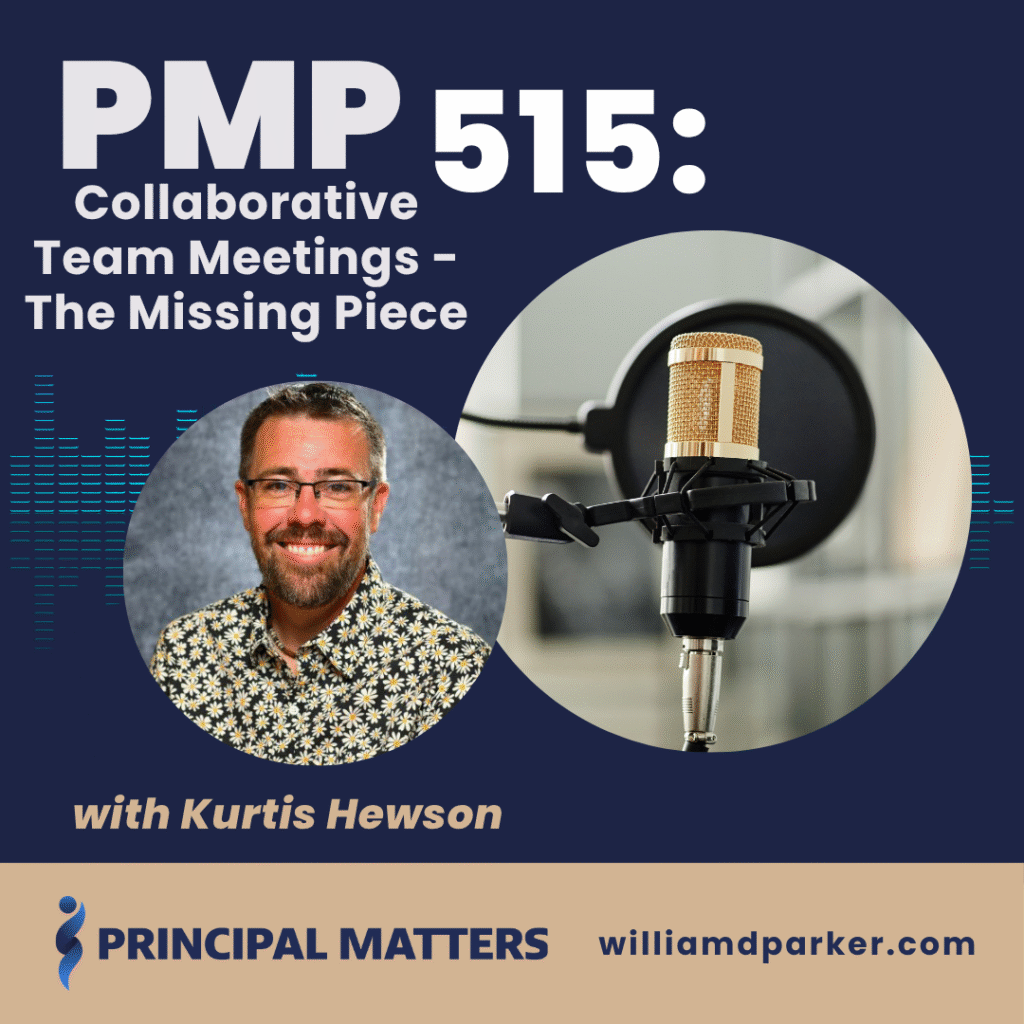
Kurtis Hewson is an award-winning educator, former teacher and administrator, and a respected post-secondary instructor. He is the co-founder of Jigsaw Learning and works with schools and districts across North America and internationally to design and implement Collaborative Response frameworks that improve outcomes for all learners.
Known for his practical, systems-level approach, Kurtis supports thousands of educators each year in strengthening collaboration, assessment, and responsive instruction. He and his wife, Lorna Hewson, have an upcoming book, Collaborative Team Meetings: The Piece Connecting PLCs and MTSS, focused on helping schools build powerful collaborative team meetings—an essential structure within the Collaborative Response framework that empowers educators and directly impacts student success.
Joining us from Lacombe, Alberta, Canada, Kurtis brings both classroom experience and leadership insight to help schools create systems that truly support every learner. He previously joined me on Principal Matters in 2024. You can listen to that episode here.
Moving from Groups to Teams:
One of the most powerful themes from our conversation was the distinction between working in groups and working as a team. Kurtis reflected on lessons learned from Richard DuFour and explained that many schools operate as collegial groups where people enjoy one another, share ideas, and support each other. While those qualities are valuable, true collaboration requires something deeper. Teams are willing to challenge assumptions, examine practices openly, and engage in conversations that can sometimes feel uncomfortable because they are focused on growth rather than simply maintaining harmony.
The schools that make the greatest progress are not necessarily the schools with the most programs. They are the schools that intentionally build trust, safety, and structures that allow adults to learn together. As Kurtis put it, collaboration often means becoming comfortable being uncomfortable because meaningful learning happens when we invite others into our thinking and practice.
The Four Layers of Collaboration:
Kurtis described four layers of collaboration that exist in effective schools. He emphasized that these layers apply whether a school has five staff members or 150. Each serves a distinct purpose, but together they create a connected system of support.
The first layer is Collaborative Planning, where teams focus on curriculum, standards, assessments, and instructional planning. This is where traditional PLC work often lives.
The second layer is Collaborative Team Meetings, which Kurtis describes as the missing piece. These meetings focus on instructional challenges, shared problem-solving, and expanding the collective capacity of teachers before concerns escalate to formal intervention processes.
The third layer is the School Support Team, which coordinates additional interventions, services, and supports for students who need more than classroom-level responses.
The fourth layer is Case Consult, where teams focus on individual students or families whose situations require highly personalized attention and, in some cases, support from outside agencies.
What struck me most was Kurtis’s observation that many schools have the first, third, and fourth layers in place but often overlook the second. Without that bridge, teachers can quickly move from classroom concerns to formal referrals without fully leveraging the collective expertise already present within the building.
What Makes Collaborative Team Meetings Different?:
Traditional meetings often begin with a student. Collaborative team meetings begin with a challenge. Instead of launching into a lengthy discussion about a particular child, the teacher identifies a key issue such as reading comprehension, task completion, classroom engagement, or on-task stamina. The conversation then focuses on strategies rather than stories.
This subtle shift changes everything. When teachers discuss the challenge first, they quickly discover that others are experiencing similar issues. The conversation becomes less about diagnosing a single student and more about expanding the team’s toolbox of responses. The result is a culture where educators learn from one another and leave meetings with practical ideas they can implement immediately.
A Meeting Structure That Builds Collective Efficacy:
One of the most practical parts of our conversation was Kurtis’s explanation of what these meetings actually look like. Several elements are consistently present in effective collaborative team meetings:
- Begin with celebrations and successes.
- Ask what contributed to those successes.
- Identify a specific instructional challenge.
- Invite colleagues to share strategies and ideas.
- Commit to one action step before leaving the meeting.
Rather than treating success as something to acknowledge briefly before moving on, Kurtis encourages teams to examine it closely. Asking, “What did you do that contributed to that success?” helps educators identify effective practices and share them with colleagues. Over time, this creates stronger collective efficacy because teachers begin to see the impact of their actions more clearly.
Why This Matters for School Leaders:
I was particularly struck by Kurtis’s observation that collaborative team meetings are not ultimately about meetings at all. They are about creating habits of thinking. The real evidence of success is when teachers begin asking one another for ideas, experimenting with new approaches, and seeking solutions together long after the meeting has ended.
As we wrapped up, Kurtis challenged us to think beyond immediate solutions and instead create structures that empower others to respond effectively. Sustainable improvement happens when systems, not just individuals, become stronger.
Now It’s Your Turn:
As you prepare for a new school year, consider where collaboration is strongest in your school and where it may be breaking down. Are your meetings creating new learning, or are they simply sharing information? Are teachers leaving with practical next steps, or are conversations ending without action? Most importantly, are your systems helping adults learn from one another in ways that ultimately benefit students? Those questions may reveal the next leadership move your school needs to make.
You can connect with Kurtis Hewson via his website, and view his Collaborative meeting Starter Kit here. Or find his new book, Collaborative Team Meetings: The Piece Connecting PLCs and MTSS here.
Thank you for listening to Principal Matters, and thank you for doing what matters!